
By now, you’ve probably heard about the dMAT and know that it plays a role in some Master’s applications to Germany. If you’re not fully sure what it is, refer to our previous article. This guide helps you determine where you stand using the latest official rules and practical examples. By the end, you should have a clear answer about whether the dMAT applies to your application.
The next question is much more important:
Do you actually need to take it? The answer isn’t as simple as yes or no.
It depends on your previous qualification, your field of study, your APS status, your intake semester, and the university you’re applying to. Many students assume that every Indian applicant must take the dMAT. Others think they are automatically exempt because they already have APS or because their degree isn’t called “Engineering.” Both assumptions can be wrong.
Quick Eligibility Checker
If you’re looking for a quick answer, start here.
Question 1: Are you applying for APS verification for a Master’s programme in Germany?
If Yes: Continue
If No: The current APS India dMAT rollout may not apply to you. Check the requirements of your university and the authority responsible for verifying your academic documents.
Question 2: Were your academic qualifications issued by an Indian educational institution?
If Yes: Continue
If No: APS India’s dMAT rules may not apply. Check your university’s admission requirements and the verification procedure for the country where you studied.
Question 3: Are you applying for Summer Semester 2027 or later?
If Yes: Continue
If No: The current APS India rollout generally does not apply to Winter Semester 2026/27.
Question 4: Does your previous degree fall under Engineering, Commerce, Finance, Economics, Business or Management?
If Yes: Continue
If No: The dMAT may not apply under the current affected-fields list. If your degree is interdisciplinary, check whether it falls into a borderline category.
Question 5: Did you complete your APS online registration or ship your complete APS documents before 29 June 2026?
If Yes: You may qualify for the transition exemption.
If No: You are likely to need the dMAT if the other eligibility conditions apply.
If you answered Yes to Questions 1 to 4 and No to Question 5, the dMAT is likely to apply to your APS process. If your degree is interdisciplinary or your APS timeline is unclear, verify your case with APS India before registering.
Sometimes a flowchart explains things better than a long paragraph.
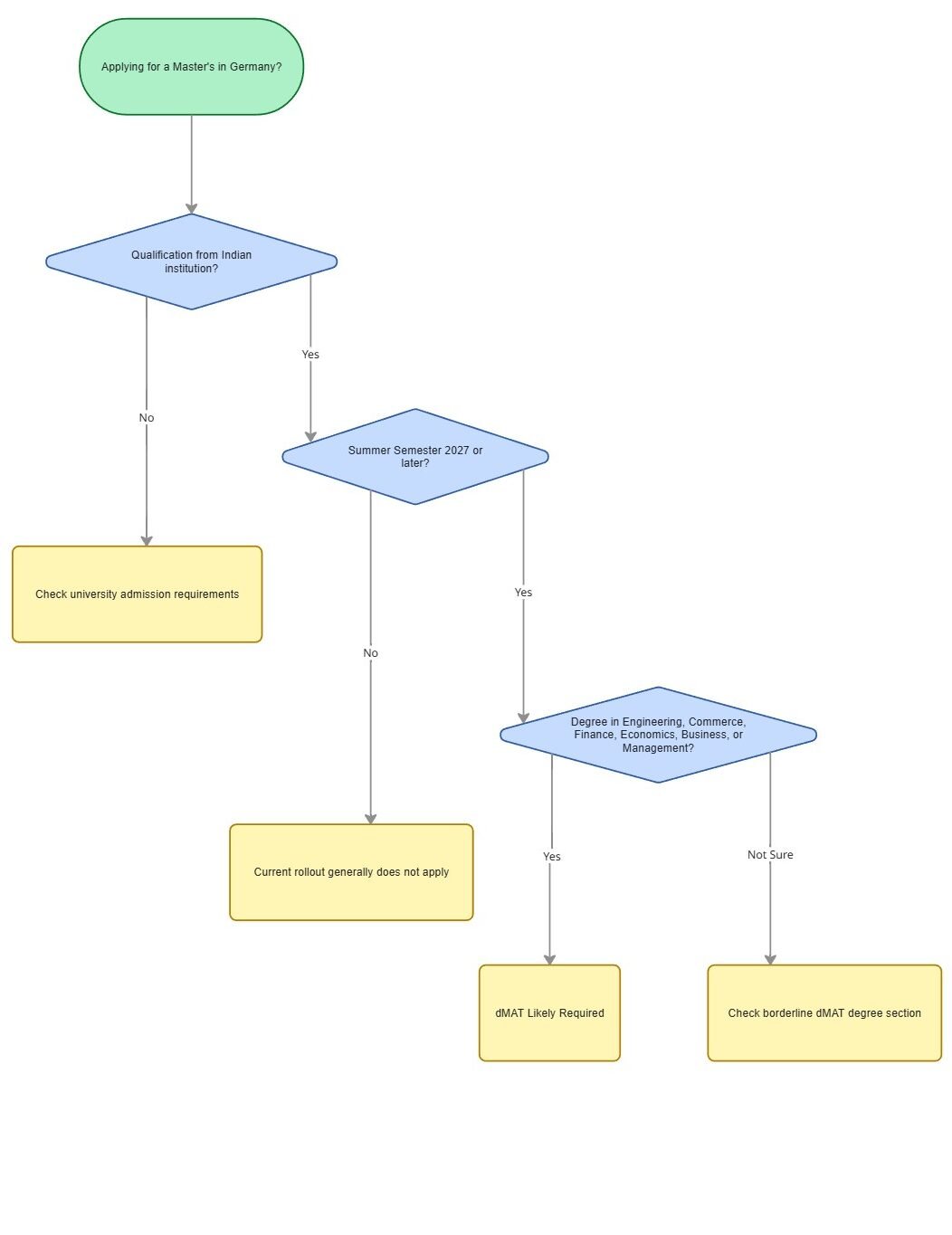
Official Eligibility Criteria
The dMAT is not based on nationality alone. This is one of the biggest misconceptions among applicants. According to APS India, what matters is whether your academic documents were issued by an Indian educational institution that falls under APS India’s responsibility. From there, APS looks at your intended intake, your field of study, and the programme you’re applying to. For the current rollout, the dMAT primarily applies to selected Master’s applicants whose previous qualification belongs to one of these broad academic groups:
Engineering, Commerce, Accounting, Finance, Economics, Business, and Management.
If your university specifically requires the dMAT and your degree falls within one of these categories, you are likely to need the test as part of your application process.
Remember that the dMAT is currently linked to the APS India rollout for Summer Semester 2027 onwards. If you’re applying for an earlier intake, the current rules may not apply.
Always verify the latest admission requirements with both your university and APS India before registering.
Borderline Degrees Need Extra Attention
This is where many students become confused. Your degree title might not fit neatly into one of the official categories. That doesn’t automatically mean you’re included or excluded. Some programmes combine multiple disciplines, making them difficult to classify at first glance.
Examples include: Business Analytics, Data Science, Financial Technology (FinTech), Engineering Management, Industrial Engineering, Hotel Management, Tourism Management, Aviation Management, Hospital Administration, and Construction Management.
For these programmes, APS India generally considers the official degree title, curriculum, duration, and academic classification, rather than simply looking for words like “Business” or “Engineering.”
For example, two universities may both offer a programme called “Business Analytics,” but the curriculum may be substantially different. One could be classified under Business and Management, while another may lean towards Computer Science or Statistics.
If your degree falls into one of these interdisciplinary categories, don’t assume you’re automatically covered by the dMAT requirement. Check the official guidance or contact APS India before making plans.
Who Does NOT Need the dMAT?
The good news is that many applicants won’t need the dMAT at all. Under the current rollout, the following groups are generally outside the requirement:
*Students applying for Bachelor’s programmes
*PhD applicants
*Exchange programme students
*Official university partnership or double-degree exchange participants
*Applicants whose universities do not require the dMAT
*Applicants who qualify under the APS India transition exemption.
Even if your friend is applying to Germany and needs the dMAT, that doesn’t automatically mean you do. Germany has more than 400 higher education institutions, and every university controls its own admission requirements. Always rely on the official admission page for your chosen programme instead of assuming the rules are identical everywhere.
APS Transition Exemption Explained
One date has caused more confusion than almost any other: 29 June 2026. APS India introduced a transition rule to avoid changing the process for applicants who had already started their APS application before the new dMAT rollout. In simple terms, you generally qualify for the transition exemption if either of these conditions applies:
✅You completed your APS online registration before 29 June 2026, or
✅Your complete APS application documents were shipped before 29 June 2026.
If you meet either condition, your APS application may continue under the previous process without requiring the dMAT.
If both happened after that date, and your application falls under the affected academic fields and intake, the dMAT is more likely to become part of your APS documentation.
The safest approach is not to guess.
If you’re uncertain which process applies to your application, verify your APS status before registering for the exam. Registering unnecessarily costs both time and money, while delaying registration after confirming you’re eligible could affect your university application timeline.
Real Student Scenarios
Scenario 1: You Most Likely Need the dMAT
Profile:
–> Bachelor’s in Engineering, Commerce, Finance, Economics, Business, or Management from an Indian educational institution
–> Applying for a Master’s in Germany for Summer Semester 2027 or later
–> APS registration or document submission completed after 29 June 2026
Likely outcome: You are likely to need the dMAT if your chosen university requires it. This is the most common scenario covered under the current APS India rollout.
Scenario 2: You May NOT Need the dMAT
Profile:
–> APS registration completed before 29 June 2026, or complete APS documents were shipped before that date
Likely outcome: You may qualify for the APS transition exemption and continue under the previous process without taking the dMAT. Always confirm your exemption status with APS India and your university.
Scenario 3: Your Degree Falls into a Borderline Category
Profile:
–> Bachelor’s in Business Analytics, Data Science, FinTech, Engineering Management, Hotel Management, Tourism Management, or another interdisciplinary programme
Likely outcome: There isn’t a universal answer. APS India and your university may evaluate your degree based on its official title, curriculum, and academic classification. Don’t assume you need the dMAT or that you’re exempt. Verify your eligibility before registering.
Country-Specific Situations
Many students compare their situation with friends or classmates. Unfortunately, every application is different. Here are a few common situations.
I am an Indian citizen but studied outside India.
Your nationality does not automatically determine whether the dMAT applies. The issuing institution and APS process are more important than your passport.
I am not an Indian citizen but completed my degree in India.
APS responsibilities are linked to where your academic qualifications were issued. If your degree comes from an Indian institution covered by APS India, check the latest APS guidance carefully.
I already received admission from a university.
Receiving admission does not automatically remove future documentation requirements. Follow the instructions provided by your university and APS.
My friend didn’t need the dMAT.
That’s completely possible. Different universities, programmes, admission years, and APS timelines may have different requirements. Never assume your application will follow someone else’s experience.
Frequently Asked Questions
Is dMAT compulsory for every Master’s applicant?
No. It currently applies only to selected Master’s programmes and universities under the present rollout.
My degree is Business Analytics. Do I need the dMAT?
It depends on how your programme is classified. Business Analytics is considered a borderline degree, so check the official requirements carefully.
I already have an APS Certificate. Do I still need the dMAT?
Not necessarily. Your APS completion date and the transition rules are important factors. Review the official APS guidance for your case.
Does having a high CGPA exempt me from the dMAT?
No. Academic performance and the dMAT are separate admission criteria.
My university website doesn’t mention the dMAT.
Then follow the official admission requirements published by that university. Not every institution has adopted the dMAT.
Does the dMAT apply to Bachelor’s admissions?
No. The current rollout focuses on selected Master’s programmes.
Does the dMAT apply to PhD admissions?
Generally, no. Doctoral admissions follow different procedures.
I am applying for Winter Semester 2026/27. Do I need the dMAT?
The current APS India rollout is aimed at Summer Semester 2027 onwards. Always verify the latest announcements in case requirements change.
Can universities have different dMAT requirements?
Yes. Every university decides whether to use the dMAT and how it fits into its admission process.
Where can I confirm my eligibility?
Always check: APS India, The official dMAT website, Your university’s admission page
nline forums.
What Should You Do Next?
Hopefully, you now know whether the dMAT is likely to apply to your application. If your answer is “Yes, I probably need it,” don’t wait until the last minute. Your next step is learning how to register correctly, choose the right test centre, understand the APS timeline, and avoid common registration mistakes.
Read our next guide: How to Register for the dMAT (2026): Step-by-Step Application, Fees, Test Centres & APS Timeline
It walks you through the entire registration process, from creating your account to receiving your examination confirmation. Still unsure about your eligibility? Every student’s academic background is different. If your degree falls into a borderline category or your APS timeline is unclear, the Sahaaya team can help you understand your options before you spend time or money on the wrong process.
Ready to Plan Your Germany Master’s Journey? Don’t let uncertainty delay your application.
Book a FREE consultation with Sahaaya, and we’ll help you understand your eligibility, APS requirements, university options, and the next steps based on your academic profile.
Official Resources:
APS India, Official dMAT India page by g.a.s.t., Official list of affected study fields, Official dMAT registration portal, Official dMAT Terms and Conditions, Official dMAT certificate information
Keywords:
dMAT Eligibility, Do I Need dMAT, dMAT, Exemption, APS Rules, Germany, dMAT Germany 2026, dMAT eligibility India, do I need dMAT, dMAT exemption, APS India, APS Germany, Summer Semester 2027, dMAT Engineering, dMAT Commerce, dMAT Finance, dMAT Economics, dMAT Business Management, Business Analytics Germany, Data Science Germany, FinTech Germany, Hotel Management Germany, Tourism Management Germany, Master’s in Germany, Germany admission requirements, Study in Germany, Indian students Germany, APS transition exemption, Germany Master’s application, dMAT requirements, Germany university admissions, APS Certificate Germany

Scientifically trained, Globally experienced ! From molecules to milestones, my journey spans India, Australia, and Germany. Today, I combine professional expertise with lived international experience to guide students navigating life and education in Europe. Fluent in Research, Resilience, and yes.. espresso-fueled Telugu playlist 

 WhatsApp: +91-9553951859 Email: sahaaya.corner@gmail.com