
You just finished your Master’s in France. You’re exhausted, relieved, and maybe a little terrified because nobody at your university clearly explained what happens to your visa now. Do you have a year to find a job? Two years? Does it depend on your passport? (Spoiler: yes, it depends on your passport, and if you’re Indian, that’s actually good news).
Here’s the confusion in one sentence: France offers different post-study pathways depending on your nationality and circumstances, they sound similar, they get used interchangeably by people who should know better, and mixing them up can quietly cost you months of job-search time you didn’t need to lose. Let’s fix that.
APS and RECE are not the same thing, and the difference matters
RECE stands for Recherche d’Emploi / Création d’Entreprise, and it’s the general post-study permit available to international graduates from countries without a specific migration agreement with France. It gives you 12 months to find a job or start a business, and that’s it. No renewal, no second round.
APS stands for Autorisation Provisoire de Séjour, and it exists because France signed bilateral migration agreements with a handful of countries, India included. If you’re Indian and you hold a French degree at least equivalent to a Master’s, you don’t apply under the standard RECE. You apply under the APS instead, and it comes with more favourable conditions.
Here’s the part that trips up even consultants: most international graduates apply under the RECE framework. Indian graduates applying from within France may instead receive an APS, which generally offers better renewal terms. It’s not that Indian graduates are choosing between two unrelated visas, it’s that the bilateral agreement gives them access to a more favourable route within the same broad system. That distinction matters later, because if you ever leave France and reapply from India, you can end up back under standard RECE-style terms even though you’re Indian.
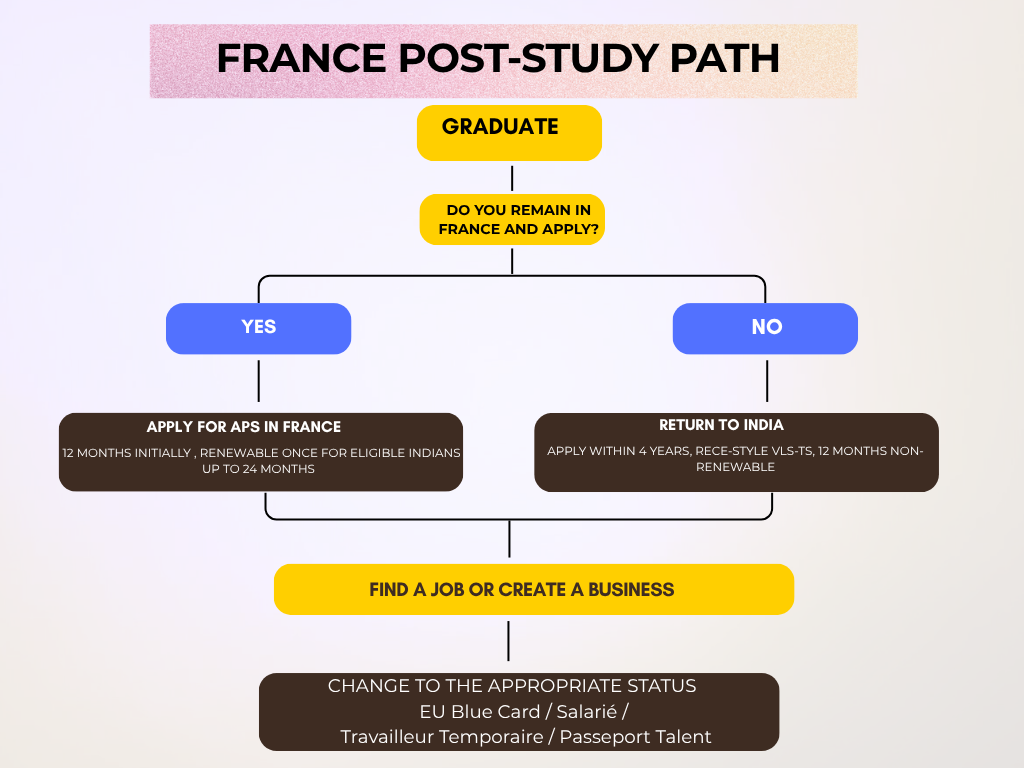
France and India signed a migration and mobility partnership agreement in 2018, ratified in 2021, and a French Senate report on that agreement spells out exactly what Indian graduates are entitled to: a 12-month APS that’s renewable once, giving you a full 24 months in France to find work matching your qualifications. That’s double what most nationalities get, and it’s written into an actual bilateral treaty, not a rumor floating around student forums.
The countries covered by this kind of agreement, alongside India, are Benin, Burkina Faso, Cape Verde, the Republic of Congo, Gabon, Georgia, Mauritius, Montenegro, North Macedonia, Serbia, Bosnia and Herzegovina, and Tunisia. If you’re advising or reading this as someone from one of those countries too, the same logic applies.
Why Indians get the better deal, and why it’s not unlimited?
The France-India agreement didn’t happen out of goodwill alone. It’s part of a broader push to strengthen academic and professional ties between the two countries, and the numbers back that up. The France–India Migration and Mobility Partnership also includes a framework for exchanges of young professionals. While the agreement contains annual limits for some mobility programmes, the APS itself remains a residence pathway defined by the bilateral agreement and French immigration rules. The agreement reflects France’s broader strategy to strengthen academic and professional mobility between the two countries.
This is also why timing your application correctly actually matters. The advantage is tied to going through the process properly while you’re still in France, not to your passport alone.
Does this apply to other countries too?
The APS isn’t an India-only arrangement. It applies to every country that has signed a bilateral migration agreement with France, but the terms aren’t identical across the board, and India actually landed one of the better deals.
For most of the other bilateral countries, like Benin, Burkina Faso, Mauritius, and Tunisia, the APS is issued for 6 months at a time and renewable once, capping out at 12 months total. India’s agreement, signed in 2018 and ratified in 2021, negotiated something stronger: a 12-month APS renewable once, for 24 months total. So an Indian graduate and a Tunisian graduate are both technically “on the APS,” but the Indian graduate gets twice the runway to find a job.
The work rights, the 964-hour cap while job hunting, and the conversion process once you land a contract stay the same across every bilateral country. What varies from country to country is purely the initial duration and how many times it renews, since each agreement was negotiated separately on its own terms. So don’t assume “APS means 2 years” if you’re reading this as a student from a different bilateral country. Check your specific agreement, since the framework is shared but the runway isn’t.
APS vs RECE at a glance
Who it’s for?
- APS (India): Bilateral-agreement countries, India included.
- RECE (standard): Most other non-EU graduates.
Apply from within France
- APS (India): Yes.
- RECE (standard): Yes.
Apply after returning home
- APS (India): Reverts to standard RECE-style VLS-TS.
- RECE (standard): Yes, within 4 years of the degree.
Initial validity
- APS (India): 12 months.
- RECE (standard): 12 months.
Renewable
- APS (India): Yes, once, for Indian graduates.
- RECE (standard): No.
Total possible stay
- APS (India): Up to 24 months.
- RECE (standard): 12 months.
Purpose
- APS (India): Job search or business creation.
- RECE (standard): Job search or business creation.
Application cost
- APS (India): Free.
- RECE (standard): Free.
How to actually apply for your APS?
Here’s the part most explainer articles skip: the practical, step-by-step reality.
- Eligibility first: You need a degree that’s at least a “licence professionnelle” or equivalent to a Master’s: an engineering diploma, a Sciences Po degree, an accounting and management diploma, or similar. If you’ve completed your Master’s but the university hasn’t issued your final diploma yet, don’t panic. Request an “attestation de réussite” from your university confirming you passed, and use that to apply instead.
- Timing: Apply during the last two months before your current student residence permit expires. Many prefectures explicitly recommend this window, and waiting until the last minute is how people end up in administrative limbo with a récépissé instead of an actual permit. If you apply before expiry, you’ll get a récépissé (an official waiting document) while your file is processed, and then the actual APS once it’s approved.
- Where: The application goes through the online portal administration-etrangers-en-france.interieur.gouv.fr, where you select the APS application and upload your documents. You’ll need your current residence permit, proof of nationality, proof of civil status, proof of address less than six months old, and your diploma or attestation de réussite.
- Processing time: The official government portal reports estimates of about 10 days in the best case, around 18 days if the prefecture needs some back and forth, and around 2 months if your file is incomplete. These figures come from one prefecture’s data and processing times do genuinely vary by location and workload, so treat them as a general guide rather than a guarantee, and submit a complete file the first time regardless.
- Cost: Free. No fee attached to the APS application itself.
The 964-hour rule worth knowing
While holding an APS or RECE, you’re not restricted to internships or part-time work like you were as a student. You can work a salaried job while you search for something permanent or build your business, under the conditions attached to your permit. Officially, the cap is 60% of legal full-time work, which works out to about 964 hours a year, roughly 20 hours a week, until you sign a definitive fixed-term or permanent contract. Once you sign that contract, the hour restriction no longer applies and you move toward changing your status entirely.
If you leave France before applying, your options change
This is the part that trips people up the most. If you finish your degree, move back to India, and never apply for the APS while still on French soil, you haven’t lost the option completely, but it changes the post-study pathway available to you.
You can still apply for a post-study permit from India, through the French consulate, within 4 years of getting your degree. But this route generally gets processed under standard RECE terms: 12 months, not renewable. The 24-month advantage tied to the bilateral agreement is generally tied to applying while you’re still legally resident in France. If you’re on the fence about staying a few extra weeks to file your APS versus flying home first, this is the exact calculation to run.
Turning your APS into a real work permit
The APS or RECE was never meant to be permanent. It’s a bridge. Once you land a job, here’s where you’re headed next:
If your employment and salary meet the requirements applicable at the time of your application (generally around 1.5 times the French minimum wage, a threshold that updates each year along with the SMIC, so check the current figure when you apply), you convert into a “salarié” or “travailleur temporaire” residence permit, or in some cases a Passeport Talent, which comes with its own perks for skilled professionals. The conversion itself needs to happen before your APS expires, so don’t let month 11 sneak up on you without a plan.
No, France did not give you a 5-year work visa
You’ve probably seen this floating around Instagram and YouTube: “France now gives Indian students a 5-year visa after their Master’s.” It’s real, but it’s not what people think it is.
In 2023, during PM Modi’s Paris visit, France announced a 5-year multiple-entry Schengen visa for Indian alumni who completed a Master’s degree or higher and spent at least one semester studying in France. Confirmed directly by the French Embassy in India and Campus France India. Here’s the catch: it’s a short-stay circulation visa, capped at 90 days in any rolling 180-day period, meant for tourism and business visits so alumni can stay connected to France. It does not let you work, and it does not let you look for a job. If you want to actually live and work in France after graduating, that’s the APS or RECE route covered above, not this one. Don’t let the two get mixed up in your head, or in your content if you’re advising students.
APS / RECE vs 5-Year Alumni Visa
Lets you live in France
- APS / RECE: Yes.
- 5-Year Alumni Visa: No, short stays only.
Lets you work
- APS / RECE: Yes, under permit conditions.
- 5-Year Alumni Visa: No.
Lets you search for a job
- APS / RECE: Yes.
- 5-Year Alumni Visa: No.
Entry type
- APS / RECE: Long-stay residence permit.
- 5-Year Alumni Visa: Multiple-entry Schengen visa.
Stay limit
- APS / RECE: Continuous, up to the permit’s validity.
- 5-Year Alumni Visa: 90 days within any 180-day period.
Renewable
- APS / RECE: Yes, once, for Indian graduates on APS.
- 5-Year Alumni Visa: Valid up to 5 years as issued.
The mistake almost everyone makes
Waiting is the big one. People treat the APS year (or two years, if you’re Indian and playing it right) like a long runway and start job hunting seriously around month 9 or 10. Don’t do that. Start applying during your final semester, or during your internship if you’re doing one. The APS clock starts ticking from day one, not from whenever you feel ready, and the students who convert successfully are almost always the ones who started early.
A few other ways people trip themselves up:
- Assuming APS and RECE are interchangeable names for the same thing, when the terms and renewal rules actually differ.
- Believing the 5-year Alumni visa lets them job hunt or work in France (it doesn’t).
- Flying home right after graduation without realizing it changes the post-study pathway available to them.
- Not requesting an attestation de réussite when the official diploma is delayed.
- Missing the two-month application window before the student permit expires and ending up stuck on a récépissé for longer than necessary.
Quick answers to what everyone asks
- Can I apply for the APS without my final diploma?
Yes. Get an attestation de réussite from your university confirming you passed, and use that while you wait for the official diploma. - Is the APS available to Bachelor’s graduates?
No. You need at least a licence professionnelle or a degree equivalent to a Master’s. - Can Indian graduates actually renew the APS?
Yes, once, for a total of up to 24 months, provided you applied and are processed within France. - Does the 5-year Alumni visa let me work or job hunt?
No. It’s a short-stay Schengen visa for tourism and business travel only, capped at 90 days per 180-day period. - What happens if I don’t find a job before my permit expires?
You’d need another legal basis to stay, or you leave France. There’s no automatic extension beyond what your permit already allows, so plan your timeline with a buffer.
Three situations that cover most readers
“I finished my Master’s, stayed in France, and applied for my APS. I found a job after 11 months.”
You’re in good shape. Once you sign that contract, apply to convert to a salarié or travailleur temporaire permit before your APS runs out, and you don’t need to wait for the full 24 months to be available.
“I graduated and went back to India. Six months later, I got a job offer in France.”
You’re still within the 4-year window, so you can apply through the French consulate. Just plan for standard RECE-style terms this time, not the 24-month version, since that advantage is tied to applying while still in France.
“My university hasn’t issued my diploma yet, but I’ve finished everything.” Don’t
Wait. Get an attestation de réussite from your university and use it to apply for the APS on time. The final diploma can follow later.
From APS to a settled life in France, roughly
Month 1 to 2: apply for your APS, get your récépissé, then your permit. Month 3 onwards: job search, up to 964 hours of paid work allowed in the meantime. Somewhere between month 6 and month 20: a job offer that meets the salary and qualification requirements. Once that happens: apply to convert to a salarié, travailleur temporaire, or Passeport Talent permit before your APS expires. From there, you’re on the standard employee residence track, and questions about long-term residence or French citizenship become relevant, but that’s genuinely a separate topic with its own rules and timelines, worth its own article rather than a rushed paragraph here.
What this actually means for you
If you’re an Indian student finishing a degree in France, you’re sitting on one of the more generous post-study arrangements in Europe, but only if you use it correctly. Apply on time, apply from within France if you possibly can, keep your paperwork complete the first time, and start your job search the moment your final semester begins, not after.
If you’re navigating this timeline right now and want someone to actually walk through your specific documents, deadlines, and options with you instead of guessing from a forum thread, that’s exactly what we do at Sahaaya. Get in touch, and let’s map out your next two years properly instead of hoping the prefecture is in a good mood.
Official Sources:
French Ministry of the Interior (administration-etrangers-en-france.interieur.gouv.fr)
Campus France
The France-India Migration and Mobility Partnership Agreement (French Senate report)
The French Embassy in India
Disclaimer
Immigration regulations change regularly, and individual prefectures may handle procedures slightly differently. Always verify current requirements with your prefecture or Campus France before submitting your application.

Scientifically trained, Globally experienced ! From molecules to milestones, my journey spans India, Australia, and Germany. Today, I combine professional expertise with lived international experience to guide students navigating life and education in Europe. Fluent in Research, Resilience, and yes.. espresso-fueled Telugu playlist 

 WhatsApp: +91-9553951859 Email: sahaaya.corner@gmail.com